PEG-MGF (2mg)
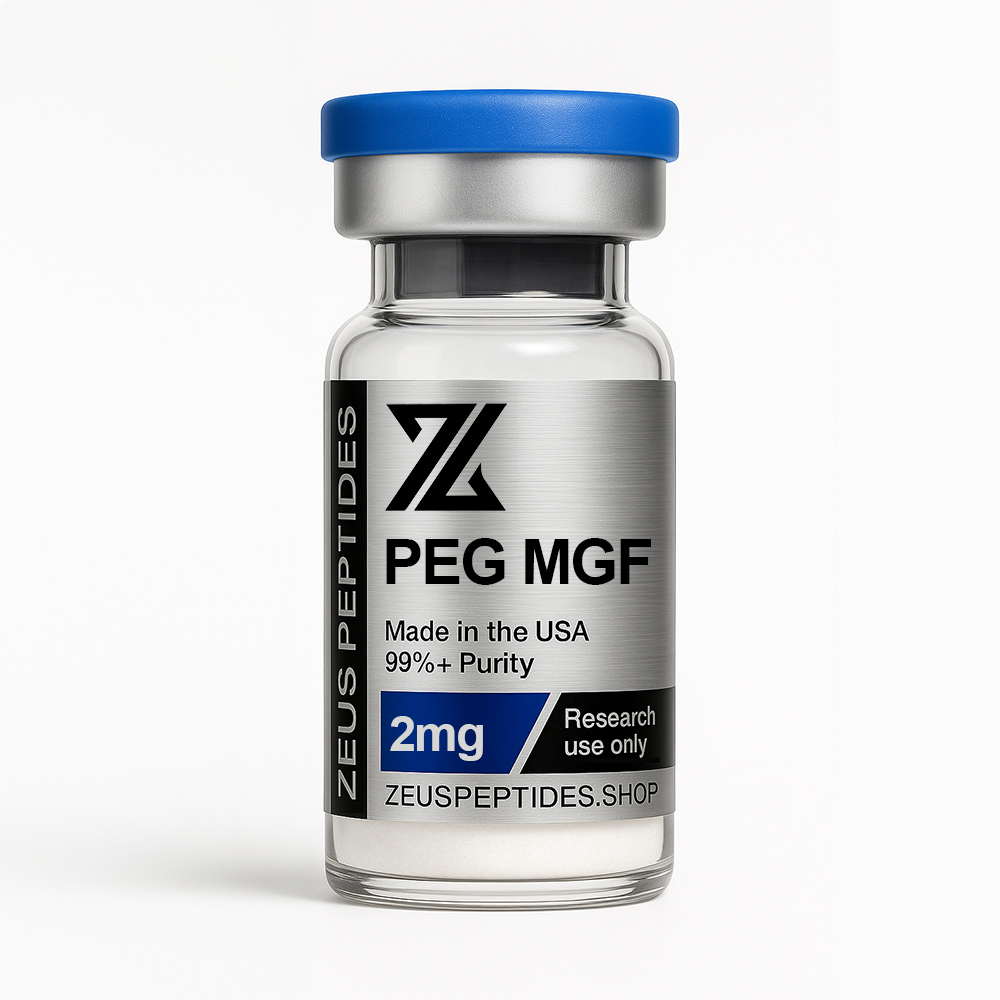
PEG-MGF (2MG) is a long-lasting, PEGylated IGF-1 Ec peptide researched for its ability to boost muscle repair signals, support faster recovery, and promote new cellular growth. Its extended stability makes it a powerhouse for studies exploring strength adaptation, tissue resilience, and enhanced regeneration pathways—all backed by the unmatched purity of Zeus Peptides.
$39.99
What is PEG-MGF?
PEG-MGF (PEGylated Mechano Growth Factor) is a modified version of the IGF-1 Ec splice variant designed to last longer, stay active in research settings, and deliver stronger performance compared to standard MGF. By attaching a PEG molecule, the peptide becomes more stable and offers extended activity—making it a favorite across labs studying muscle repair, growth signaling, recovery pathways, and cellular adaptation.
PEG-MGF is supplied exclusively for research and in-vitro studies. It is not for human or veterinary use.
What Are the Effects of PEG-MGF?
PEG-MGF is often researched for its ability to support powerful muscle-related and cellular recovery pathways. In easy-to-understand terms, studies show it may:
- Support faster tissue recovery after physical strain or cellular stress models
- Promote muscle repair signals by activating satellite cell pathways in vitro
- Help stimulate new cell growth in muscle-related research environments
- Support improved adaptation and resilience in experimental stress-response models
- Extend activity duration compared to non-PEGylated MGF, thanks to longer peptide stability
Researchers appreciate PEG-MGF because it provides a longer signaling window, making it ideal for studies involving growth factors, recovery dynamics, and structural repair.
Chemical Structure of PEG-MGF
- Peptide Class: IGF-1 Ec variant (Mechano Growth Factor)
- Modification: PEGylated for extended half-life and increased peptide stability
- Form: Lyophilized powder, 2mg
- Purity: ≥99% (HPLC)
This PEGylated structure helps protect the peptide during research use, allowing for longer experimental windows and more consistent results.
The Zeus Peptides Advantage
When it comes to research peptides, Zeus Peptides stands above the rest. Every batch of PEG-MGF is produced with exceptional precision, third-party testing, and a commitment to purity that researchers rely on for consistent outcomes.
- Ultra-High Purity: 99%+ verified
- USA-Made Quality: Clean, reliable, and trustworthy
- Premium Packaging: Designed to protect peptide integrity
- Researcher-Trusted: Zeus Peptides is known for reliability and consistency across all compounds
If your lab depends on accuracy, repeatability, and clean data, Zeus Peptides delivers industry-leading performance every time.
Storage & Handling Information
Zeus Peptides products are prepared using an advanced lyophilization (freeze-drying) process designed to protect compound integrity. This method allows peptides to remain stable during transit for approximately 3–4 months without degradation.
Once a peptide has been reconstituted with bacteriostatic water, it must be stored under refrigeration to maintain its stability. After mixing, reconstituted solutions are generally stable for up to 30 days when kept cold.
Lyophilization—sometimes referred to as cryodesiccation—is a controlled dehydration technique in which peptides are frozen and placed under reduced pressure. This environment causes moisture within the vial to convert directly from ice to vapor, resulting in a dry, crystalline powder. In this unreconstituted state, peptides may be safely kept at room temperature until preparation is required.
After delivery, peptides should be shielded from light and excessive heat. For short-term use—ranging from days to several weeks or months—refrigerated storage below 4°C (39°F) is typically sufficient. Lyophilized peptides often tolerate room-temperature storage for limited periods, making this acceptable when use is planned relatively soon.
For extended storage lasting several months or longer, peptides should be placed in a deep freezer at -80°C (-112°F). Long-term freezing offers the highest level of stability and is the preferred method for preservation over time.