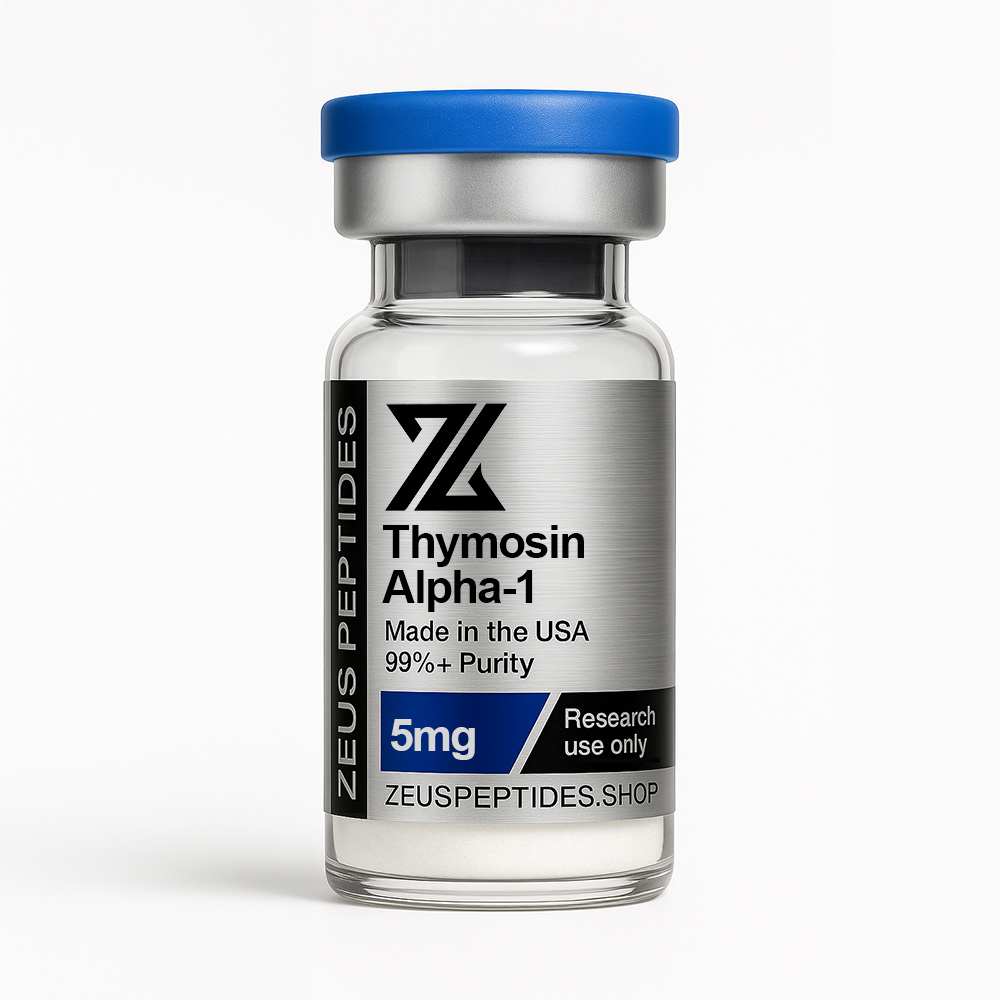
Thymosin Alpha-1 (5mg)
Immunomodulatory peptide for research.
$129.99
Thymosin Alpha-1 is researched for its interaction with immune signaling pathways, T-cell modulation, and innate immunity response models.
Storage & Handling Information
Zeus Peptides products are prepared using an advanced lyophilization (freeze-drying) process designed to protect compound integrity. This method allows peptides to remain stable during transit for approximately 3–4 months without degradation.
Once a peptide has been reconstituted with bacteriostatic water, it must be stored under refrigeration to maintain its stability. After mixing, reconstituted solutions are generally stable for up to 30 days when kept cold.
Lyophilization—sometimes referred to as cryodesiccation—is a controlled dehydration technique in which peptides are frozen and placed under reduced pressure. This environment causes moisture within the vial to convert directly from ice to vapor, resulting in a dry, crystalline powder. In this unreconstituted state, peptides may be safely kept at room temperature until preparation is required.
After delivery, peptides should be shielded from light and excessive heat. For short-term use—ranging from days to several weeks or months—refrigerated storage below 4°C (39°F) is typically sufficient. Lyophilized peptides often tolerate room-temperature storage for limited periods, making this acceptable when use is planned relatively soon.
For extended storage lasting several months or longer, peptides should be placed in a deep freezer at -80°C (-112°F). Long-term freezing offers the highest level of stability and is the preferred method for preservation over time.