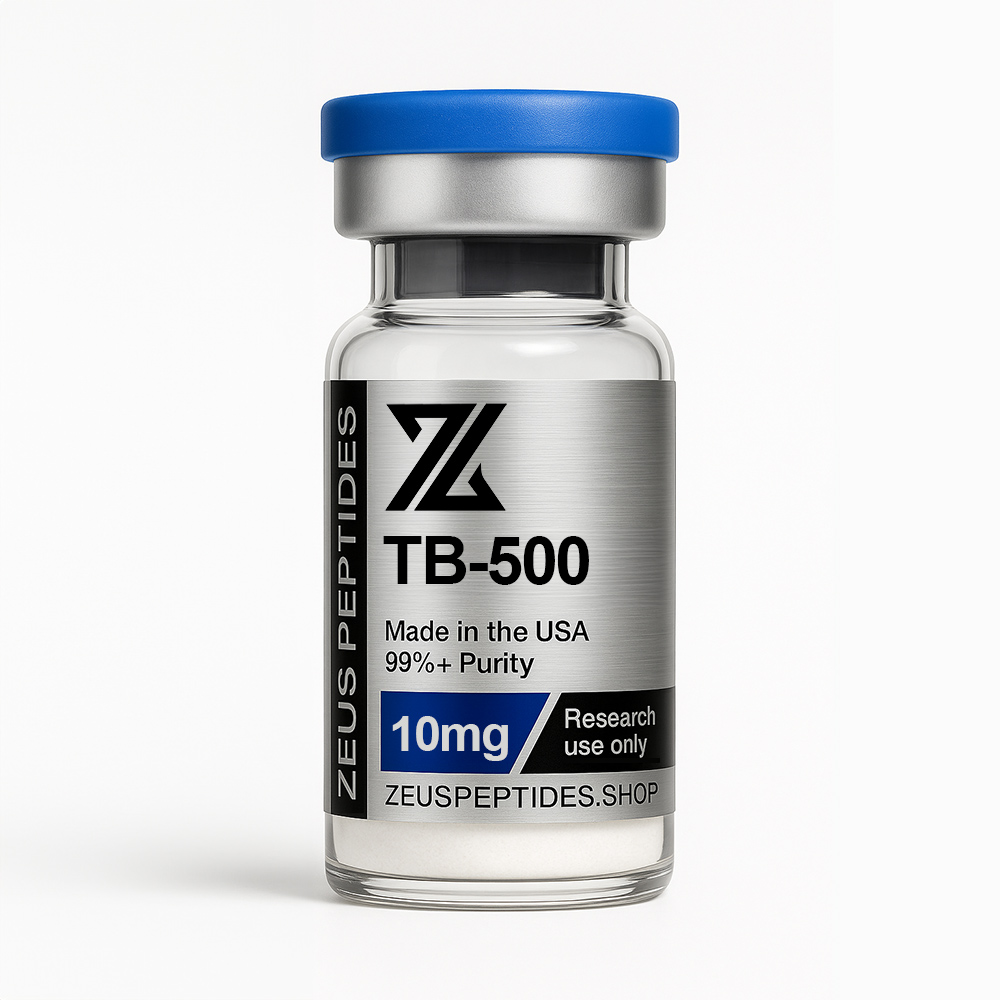
TB-500 (10mg)
TB-500 (10MG) is a high-purity research peptide modeled after Thymosin Beta-4 and commonly studied for its role in tissue repair, injury recovery, inflammation control, and cellular regeneration. Researchers use TB-500 to explore its potential effects on muscle recovery, tendon and ligament support, mobility, and wound-healing pathways.
$164.99
What Is TB-500 (10MG)?
TB-500 is a research peptide modeled after Thymosin Beta-4, a naturally occurring peptide involved in tissue repair, cellular regeneration, and regulation of inflammation. It is widely studied for its potential role in supporting recovery, mobility, and overall structural repair under laboratory conditions.
Peptide Structure
TB-500 is a synthetic fragment of the Thymosin Beta-4 protein and is known as the Active Repair Region (Ac-SDKP). This sequence is associated with improved cellular migration, angiogenesis, and modulation of inflammatory pathways in experimental models.
Research Focus & Observed Effects
- Tissue Repair Support: Preclinical studies show enhanced recovery of muscles, tendons, and ligaments via improved cell migration and collagen organization.
- Mobility & Flexibility: Often used in research exploring improved range of motion and joint comfort following physical strain.
- Inflammation Regulation: Models demonstrate reduced inflammatory signaling, potentially supporting faster recovery responses.
- Angiogenesis (Blood Vessel Formation): TB-500 may help stimulate new blood vessel growth in injured tissues, supporting nutrient delivery.
- Cellular Regeneration: Research indicates increased actin regulation, which plays a key role in structural repair and tissue regeneration.
Why Researchers Use TB-500
- Consistent recovery modeling for sports injury, tendon strain, and soft-tissue repair studies.
- System-wide therapeutic interest due to its ability to circulate efficiently in experimental models.
- Broad anti-inflammatory potential across multiple tissue types.
Product Specifications
- Peptide: TB-500
- Form: Lyophilized powder
- Purity: 99%+ (HPLC Verified)
- Quantity: 10MG per vial
- Storage: Keep refrigerated after reconstitution; store powder in a cool, dry environment.
Scientific Citations
- Goldstein et al., Thymosin Beta-4 & Tissue Repair Mechanisms, J. Cell Sci.
- Philp et al., TB-500 & Actin Regulation, Exp. Cell Res.
- Hannan et al., Angiogenesis & Thymosin Derivatives, Circ. Res.
Disclaimer
This compound is intended strictly for laboratory research. Not for human use, medical use, or diagnostic applications.
Storage & Handling Information
Zeus Peptides products are prepared using an advanced lyophilization (freeze-drying) process designed to protect compound integrity. This method allows peptides to remain stable during transit for approximately 3–4 months without degradation.
Once a peptide has been reconstituted with bacteriostatic water, it must be stored under refrigeration to maintain its stability. After mixing, reconstituted solutions are generally stable for up to 30 days when kept cold.
Lyophilization—sometimes referred to as cryodesiccation—is a controlled dehydration technique in which peptides are frozen and placed under reduced pressure. This environment causes moisture within the vial to convert directly from ice to vapor, resulting in a dry, crystalline powder. In this unreconstituted state, peptides may be safely kept at room temperature until preparation is required.
After delivery, peptides should be shielded from light and excessive heat. For short-term use—ranging from days to several weeks or months—refrigerated storage below 4°C (39°F) is typically sufficient. Lyophilized peptides often tolerate room-temperature storage for limited periods, making this acceptable when use is planned relatively soon.
For extended storage lasting several months or longer, peptides should be placed in a deep freezer at -80°C (-112°F). Long-term freezing offers the highest level of stability and is the preferred method for preservation over time.