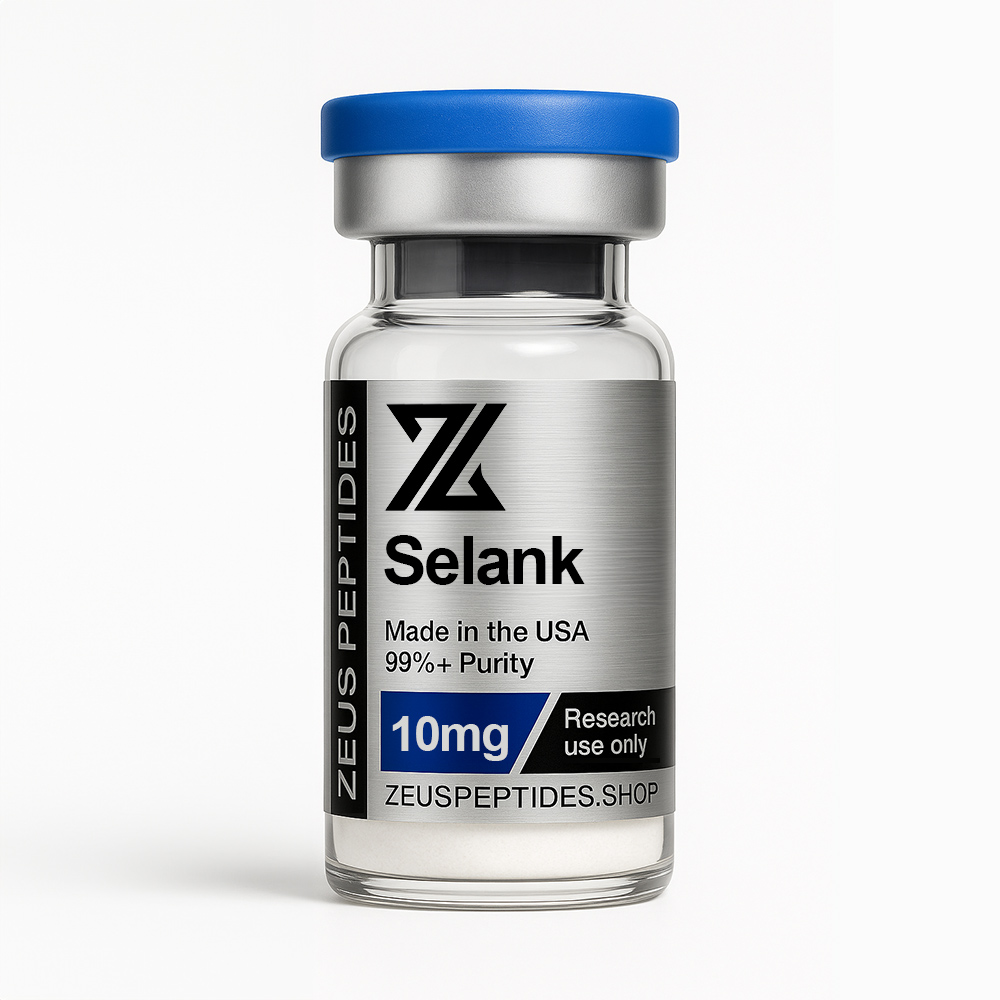
Selank (10mg)
Selank (10mg) is a premium research peptide from Zeus Peptides, designed for those exploring compounds linked to calm, clarity, and enhanced cognitive performance. Known for its gentle, non-sedating profile, Selank is widely researched for supporting stress reduction, focus, and mental resilience. Backed by ultra-high purity and trusted by serious researchers, Selank continues to be one of the most reliable peptides for studies involving mood, brain function, and neuroprotection.
$49.99
What is Selank?
Selank (10MG) is a premium research peptide widely explored for its
potential effects on calmness, mental clarity, focus, and immune balance.
Often referred to as a “researcher’s favorite,” Selank is valued for its stability,
easy handling, and broad usefulness across neuroscience and wellness-related studies.
Why Researchers Choose Selank
- Helps support stress-response research — commonly used in studies exploring reduced anxious behavior.
- Shown to influence focus and cognitive pathways — popular in nootropic and learning-related experiments.
- Immune-modulating properties — used in studies involving inflammatory markers and immune balance.
- Highly stable peptide — engineered with a PGP extension for improved durability in lab environments.
Perfect for Advanced Research
Selank is frequently studied in connection with the GABAergic system,
BDNF pathways, and various neurochemical markers involved in
stress, cognition, and mood regulation. Labs choose Selank for its
reliability, consistency, and strong research history.
The Zeus Peptides Advantage
- Ultra-high purity for precise and trustworthy results
- Made in the USA with elite-grade quality standards
- Perfect consistency vial-to-vial for predictable outcomes
- Trusted by professional research labs nationwide
All Zeus Peptides compounds are intended exclusively for scientific and laboratory research.
They are not for human consumption
Storage & Handling Information
Zeus Peptides products are prepared using an advanced lyophilization (freeze-drying) process designed to protect compound integrity. This method allows peptides to remain stable during transit for approximately 3–4 months without degradation.
Once a peptide has been reconstituted with bacteriostatic water, it must be stored under refrigeration to maintain its stability. After mixing, reconstituted solutions are generally stable for up to 30 days when kept cold.
Lyophilization—sometimes referred to as cryodesiccation—is a controlled dehydration technique in which peptides are frozen and placed under reduced pressure. This environment causes moisture within the vial to convert directly from ice to vapor, resulting in a dry, crystalline powder. In this unreconstituted state, peptides may be safely kept at room temperature until preparation is required.
After delivery, peptides should be shielded from light and excessive heat. For short-term use—ranging from days to several weeks or months—refrigerated storage below 4°C (39°F) is typically sufficient. Lyophilized peptides often tolerate room-temperature storage for limited periods, making this acceptable when use is planned relatively soon.
For extended storage lasting several months or longer, peptides should be placed in a deep freezer at -80°C (-112°F). Long-term freezing offers the highest level of stability and is the preferred method for preservation over time.